






SME Insights, ESG Reporting & VSME:
Transparency, resilience, and growth.
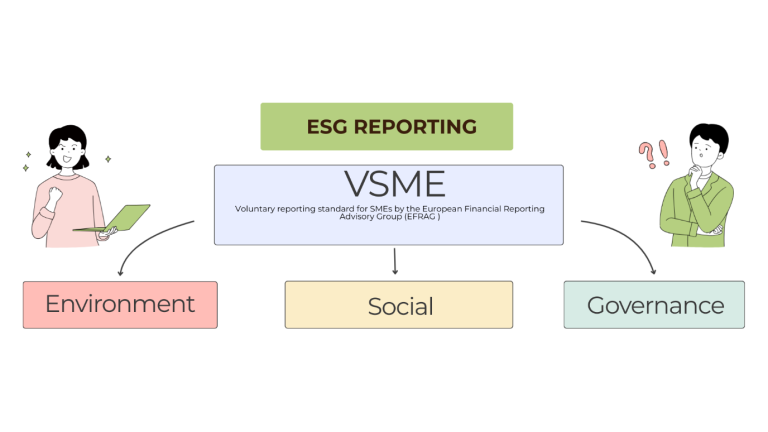
Environmental, Social, and Governance (ESG) measures how your company impacts the environment, how you treat people (both within and outside your organization), and how responsibly you manage your organization.
Paraskevi Koumadoraki
Author
What is ESG—and why is it important for your business?
ESG reporting is a way to build trust with customers, investors, financiers, and partners by showing what you do and how you do it. It provides structured information about your environmental footprint, social impact, and governance practices. This gives stakeholders insight into the risks and opportunities your organization faces, as well as the progress you are making.
Traditionally, ESG reporting was primarily the domain of large corporations. Today, however, the market increasingly expects transparent sustainability information from companies of all sizes, including small and medium-sized enterprises (SMEs).
Introduction to VSME — a practical ESG reporting standard for small and medium-sized enterprises
Although European legislation such as the Corporate Sustainability Reporting Directive (CSRD) requires large companies to provide comprehensive reporting, hundreds of thousands of small and medium-sized enterprises (SMEs) are exempt from this requirement. However, the demand for sustainability information is not limited to the size of an organization.
To support SMEs that wish to report ESG information in a structured and coherent manner, EFRAG has developed the Voluntary Sustainability Reporting Standard for SMEs (VSME). This is a simple and proportionate reporting standard.
VSME enables smaller companies to report sustainability information in a standardized format that aligns with broader European ESG frameworks (such as CSRD and ESRS), but without the complexity associated with these standards. It helps you communicate clear and reliable ESG data to customers, investors, and partners.
The VSME framework consists of two parts:
- a basic module
- a comprehensive module
You always start with the basic module. You can then expand your reporting by adding the advanced module, which covers a broader and more detailed range of ESG topics.
Business Benefits of Structured ESG Reporting
By using VSME as the foundation for your ESG reporting and expanding on it where necessary, SMEs can reap concrete and measurable benefits:
Stronger customer relationships: Major customers are increasingly asking their suppliers for ESG information in order to meet their own reporting requirements
Competitive advantage: Clear and structured ESG reporting sets you apart and demonstrates that you take transparency and continuous improvement seriously
Better internal insight: ESG frameworks help you monitor your performance and manage risks in a timely manner
How we support your ESG journey with the right tools and expertise
To turn ESG reporting into real business value, reliable data and structured assessments are essential. That’s where the right software and expert guidance make all the difference.
We recommend using digital tools that help you effectively measure, monitor, and manage ESG data—without unnecessary manual administrative work. This includes, among other things:
Risk Assessment & Evaluation Tools:
And
ClimateCalc
ClimateCalc is a leading solution for the creative industry, enabling the calculation and reporting of carbon footprints in a transparent and externally verifiable manner.
With our support, you can integrate these digital platforms into your ESG reporting. This will enable you to tell a credible sustainability story, meet stakeholder expectations, and make more informed strategic decisions.
The next step toward your own sustainability report
Getting started with ESG reporting doesn’t mean you have to completely overhaul your organization overnight. With VSME as your guide and the right tools, you can report ESG information in a clear, reliable, and valuable way for your stakeholders.
We’re here to help you understand what ESG reporting means for your business, choose the right standards, implement efficient data tools, and establish sustainability reporting that supports growth and resilience.
Let’s work together to transform ESG from a reporting requirement into a strategic advantage.
Would you like to receive more information with no obligation?
Making the right decision starts with having the right information.


